Why the Scale Doesn’t Tell the Whole Story
For decades, we’ve been taught that progress equals weight loss.
Step on the scale.
Watch the number drop.
Celebrate — or feel discouraged.
But the number staring back at you is only one data point. And often, it’s the least informative one.
If you train consistently, lift weights, and fuel your body properly, the scale can actually become misleading.
Let’s talk about why.
Weight Is a Snapshot — Not a Breakdown
Your total body weight includes:
Muscle
Body fat
Water
Bone
Organs
Glycogen (stored carbohydrates)
That means a 3-pound increase could be:
New muscle tissue
Normal hydration changes
Glycogen replenishment
Inflammation from a tough workout
Or it could be body fat.
The scale doesn’t differentiate. It simply reports total mass.
That’s like judging the quality of a car by how much it weighs.
Strength Training Changes the Equation
When you lift weights consistently, your body adapts by increasing:
Muscle fiber size
Neural efficiency
Connective tissue strength
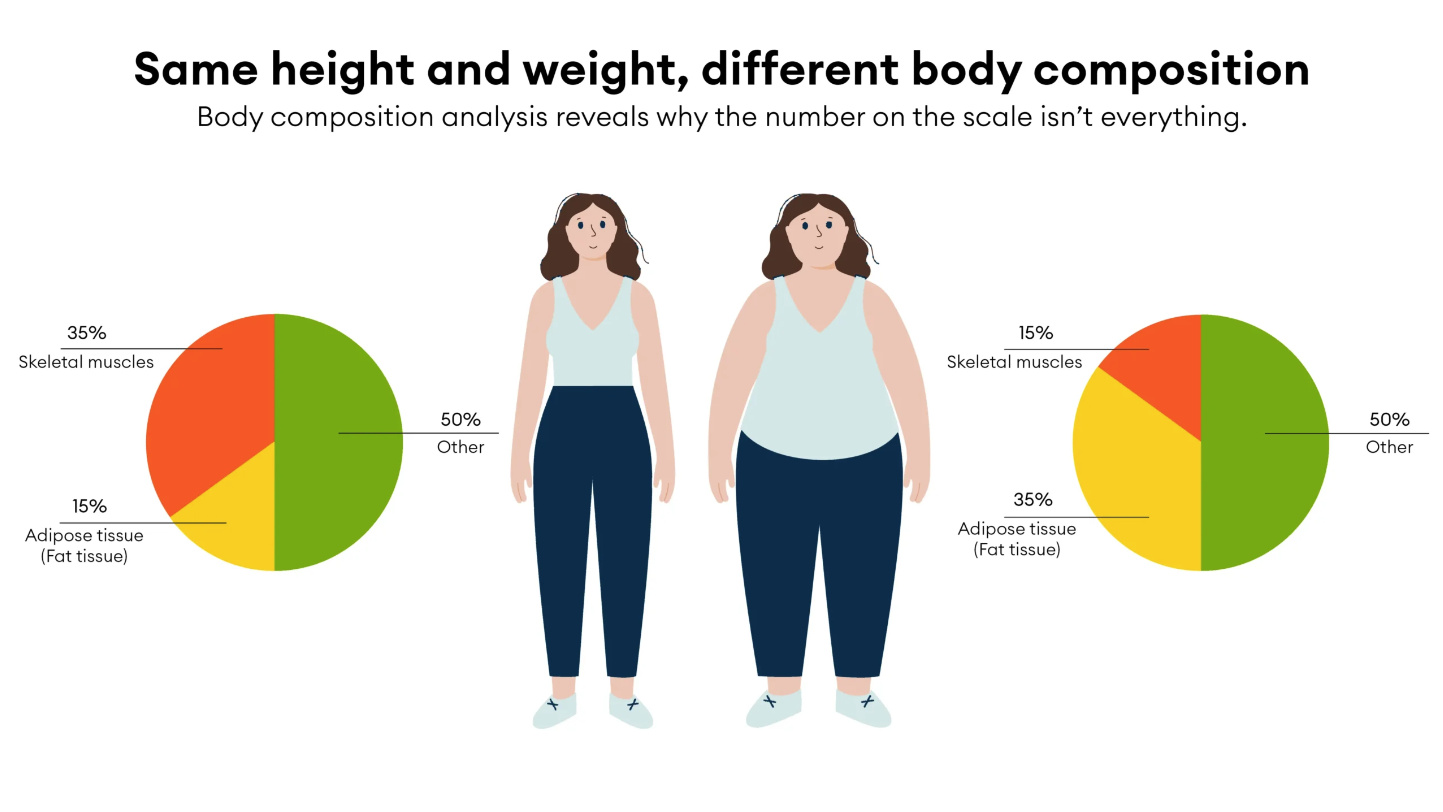
Muscle is denser than fat. That means as body fat decreases and muscle increases, your overall weight may stay the same — or even rise — while your body composition improves dramatically.
This is one of the most common frustrations people experience:
“I’m stronger. My clothes fit better. But the scale hasn’t moved.”
That’s not a lack of progress. That’s incomplete measurement.
Why Body Composition Matters for Health
Research consistently shows that lean muscle mass plays a major role in long-term health.
Higher muscle mass is associated with:
Improved metabolic rate
Better insulin sensitivity
Reduced risk of metabolic disease
Increased bone density
Lower injury risk
Body fat distribution also matters. Visceral fat (fat stored around internal organs) carries different health implications than subcutaneous fat (stored under the skin).
Again, the scale cannot tell you any of this.
Measuring What Actually Matters
If the goal is to improve health, performance, and longevity, then the measurement tool should reflect those goals.
That means tracking:
Muscle mass
Body fat percentage
Muscle balance
Metabolic indicators
This is where body composition tools come in.
Not to create obsession.
Not to chase perfection.
But to provide clarity.
A Better Way to See Progress
That’s why we’re introducing the InBody Body Composition Analyzer at the gym!
The InBody goes beyond total body weight and breaks down:
Skeletal muscle mass
Body fat percentage
Segmental muscle balance (arms, legs, trunk)
Visceral fat levels
Basal metabolic rate
Instead of guessing whether your hard work is paying off, you’ll be able to see what’s actually changing beneath the surface.
Maybe the scale hasn’t moved — but your muscle mass has increased.
Maybe your weight stayed the same — but your body fat percentage dropped.
Maybe your strength gains are now reflected in measurable data.
That’s powerful.
Data Should Empower — Not Define
One scan does not define you. One data point does not determine success. What matters most is the trend over time.
The purpose of better measurement isn’t pressure — it’s perspective.
When you understand what’s changing beneath the surface, you can:
Train more intentionally
Fuel more strategically
Set realistic expectations
Focus on strength instead of just weight
The scale can’t capture strength.
It can’t capture resilience.
And it definitely can’t capture discipline.
But better data can help you see the full story.
The Bigger Perspective
The goal isn’t just to weigh less.
It’s to move better.
To build muscle.
To support long-term health.
To feel confident in your body.
Weight is one number.
Your health is far more complex than that.
And now, you’ll have a better way to measure it.
InBody Scan Availability & Scheduling
We’re making InBody scanning available to both members and non-members.
All RZN Athletics members receive one complimentary InBody scan.
Additional scans for members are available at a reduced rate.
Non-members may schedule scans at a standard rate.
Body composition tracking is most valuable when viewed over time. For meaningful trends, we recommend reassessing every 4–8 weeks.
To schedule your scan, either:
Scan the QR code posted in the gym to view available appointment times, or
Text us at (218) 531-1005, and we’ll help you get scheduled.
If you have questions about pricing or how to prepare for your scan, our team is happy to help.